Professional CNC machines play a critical role in modern manufacturing. CNC technology has transformed how builders, fabricators, and manufacturers create products. What once required large industrial machines or extensive manual craftsmanship can now be accomplished with remarkable precision using computer-controlled equipment.
Within the world of CNC, there are many different types of machines designed for different purposes. Some machines are built primarily for learning, experimentation, and tinkering. Others are massive industrial systems designed for factory environments and high-volume production.
In addition to hobbyist and industrial machines, there is a category designed for real production work in practical shop environments. To appreciate what makes a CNC machine professional, it’s necessary to first understand how CNC technology itself operates.
What Is CNC (Computer Numerical Control)?
CNC stands for Computer Numerical Control, a manufacturing process in which machines are controlled by digital instructions rather than manual operation.
Instead of guiding a cutting tool by hand, a CNC machine follows a program of instructions known as G-code. These instructions tell the machine exactly where to move, how fast to move, and how the cutting tool should operate.
The typical CNC workflow follows three steps:
- Design (CAD) – A part or product is designed using Computer-Aided Design software.
- Toolpath Creation (CAM) – Software converts the design into machine instructions.
- Machine Execution – The CNC machine follows those instructions to manufacture the part.
Because these instructions are digital, the machine can reproduce the same part repeatedly with very little variation. That repeatability is one of the main reasons CNC technology has become foundational to modern manufacturing.
Types of CNC Machines
CNC technology is found in many types of machines. While all are computer-controlled, the tools they use and the materials they handle can differ greatly. Exploring these different machine types sets the stage for understanding the broader CNC ecosystem.
Understanding these different machine types helps provide context for the broader CNC ecosystem.
CNC Mills
CNC milling machines remove material using rotating cutting tools. These machines are commonly used to machine metals, plastics, and precision components.
They are widely used in industrial manufacturing, aerospace, automotive production, and engineering environments where tight tolerances are required.
CNC Routers
CNC routers operate on a similar principle to milling machines but are typically designed for larger work areas and different material types. These machines use high-speed rotating cutting tools to shape materials such as wood, plastics, composites, foam, and non-ferrous metals, such as aluminum.
These machines are commonly used to cut materials such as:
- hardwood and softwood
- plywood and composite panels
- plastics and acrylics
- foam and modeling materials
- aluminum and other non-ferrous metals
CNC routers are widely used in cabinet shops, furniture production, sign fabrication, and many independent manufacturing environments.
Because of their versatility and cutting area, CNC routers have become one of the most widely used CNC machine types in builder-owned production shops and independent manufacturing environments.
Related reading:
➡ What Makes a CNC Machine Professional?
➡ Professional CNC Router Guide
CNC 3D Printers
CNC 3D printers operate differently from traditional machining systems. Instead of removing material, they build parts layer by layer using additive manufacturing processes.
3D printers are commonly used for prototyping, product development, and design testing.
CNC Plasma Cutters
CNC plasma cutters use a high-temperature plasma arc to cut electrically conductive metals.
They are widely used in fabrication shops and metalworking environments where large sheet materials must be cut quickly and accurately.
CNC Laser Cutters and Engravers
Laser CNC machines use a focused beam of light to cut or engrave materials.
They are commonly used for:
- engraving
- signage
- decorative cutting
- product branding
- acrylic fabrication
The Professional CNC
Across the CNC world, there are many different types of machines, but there is also a very large group of users whose work does not neatly fit into the traditional hobbyist and industrial categories often discussed in marketing or online forums.
Many machines are either entry-level for learning or large industrial systems for factories. However, these extremes do not fully reflect the majority of CNC work being done.
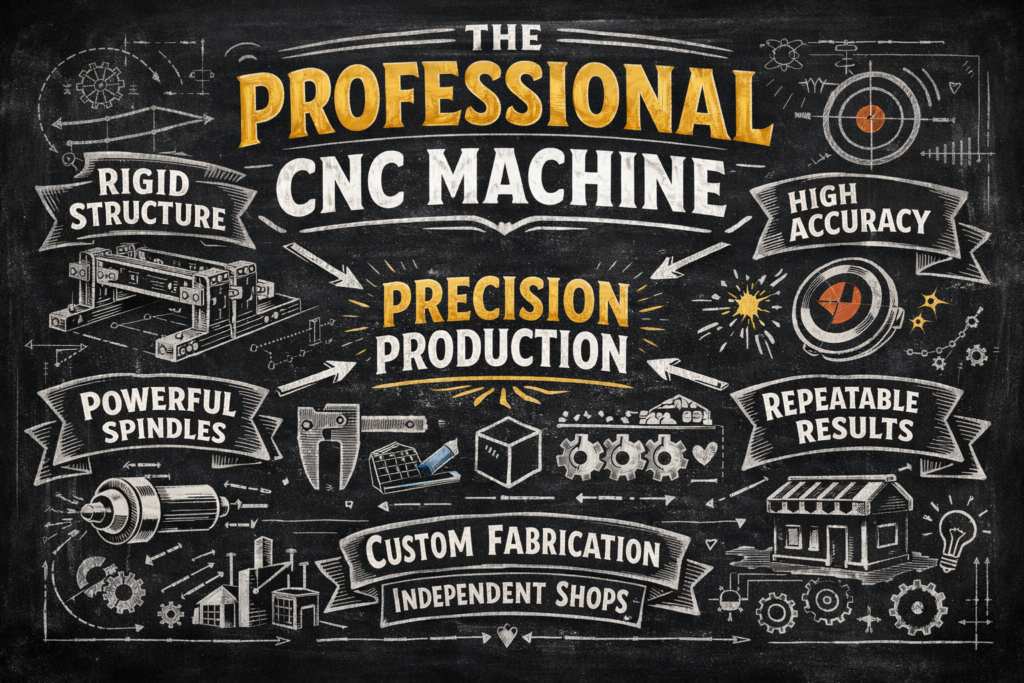
A professional CNC machine is a computer-controlled manufacturing system designed to deliver reliable, repeatable results in real production environments through rigid mechanical structures, precision motion systems, and cutting systems capable of sustained daily operation.
The professional CNC machine exists because there is a substantial community of builders, fabricators, and production shops that require real manufacturing capability in practical shop environments.
These machines are designed for people who run:
- independent production shops
- custom production shops
- builder-owned production shops
- independently owned production environments
In these shops, CNC machines are core production tools—used regularly to create parts, products, and customer work, not just for experimentation.
Because of this, the machines themselves must be engineered differently. They must provide the rigidity, precision, repeatability, and reliability required for real work while still fitting within the practical realities of independent production environments.
CNC Machine Market Categories
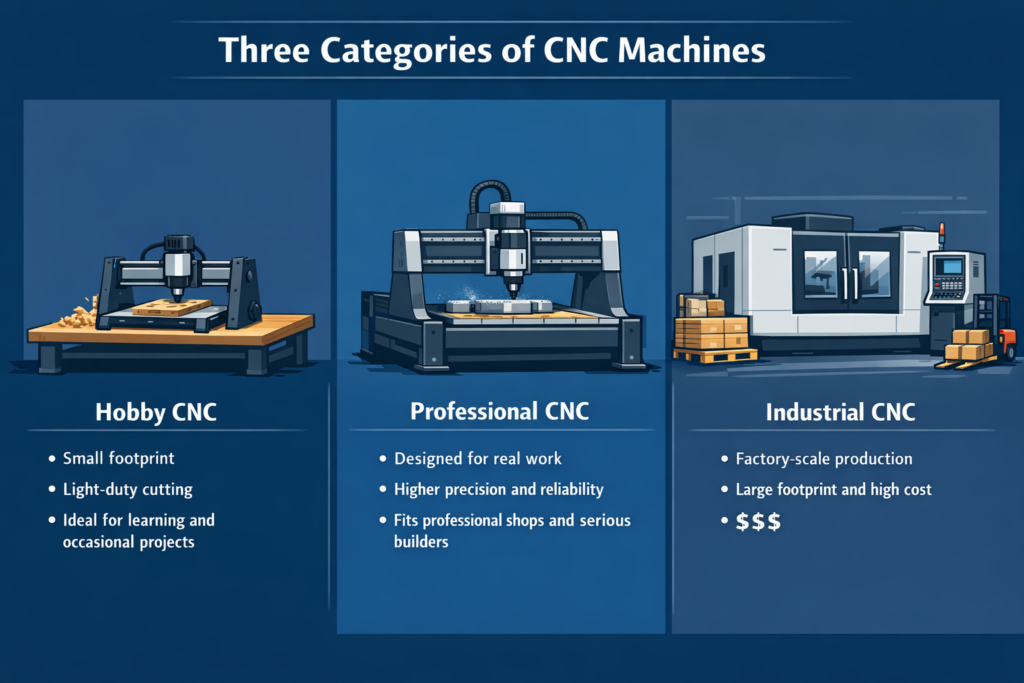
CNC machines generally fall into three broad categories based on their design and use.
| Intended Use | Learning, small projects | Business production, fabrication, prototyping | High-volume factory production |
| Frame Structure | Light-duty frames | Rigid engineered structures | Heavy welded or cast frames |
| Motion Systems | Basic lead screws or belts | Precision rails and ball screws | Industrial motion systems with servo control |
| Cutting Power | Trim routers or small tools | High-power spindles and controlled motors | Industrial spindles and tool changers |
| Accuracy | Moderate | High repeatable accuracy | High precision with large-format motion systems |
| Duty Cycle | Occasional use | Daily production use | Continuous multi-shift production |
| Size | Desktop or small shop machines | Shop-scale production machines | Large format factory machines |
| Cost | Low | Mid-range | Very high |
Each category reflects a different set of engineering priorities and operating environments.
Engineering Characteristics of a Professional CNC Machine
What ultimately defines a professional CNC machine is not just its size or price, but its engineering.
Several characteristics distinguish machines designed for real production work.
Structural Rigidity
Rigidity is one of the most important characteristics of any CNC machine.
When a machine flexes during cutting, the tool can deflect, vibration increases, and surface finish and accuracy suffer.
Hobby Machine Rigidity
Hobby CNC machines often rely on lightweight construction, such as aluminum extrusions and minimal structural mass. While suitable for light-duty work, these machines may flex slightly under load.
Professional CNC Rigidity
A professional CNC machine is designed as a complete structural system.
Rather than reinforcing a single component, the entire machine is engineered for rigidity.
This includes:
- reinforced gantry structures
- precision linear rails
- ball screw motion systems
- structurally engineered tables
- purpose-built machine stands
The stand, table, frame, gantry, and motion systems are designed together so the machine behaves as a unified structure during cutting operations.
Rigidity in a professional CNC machine is therefore not simply a result of thicker materials. It is the result of engineering design across the entire system, reinforced at multiple levels to support real production work.
Industrial Machine Rigidity
Industrial machines typically achieve rigidity through sheer structural mass.
Large welded frames, cast iron bases, and massive gantries provide stability during aggressive machining operations in factory environments.
Motion Systems
The motion system determines how accurately the machine can position the cutting tool.
Belt Systems
Many hobby CNC machines use belt-driven motion systems. Belts are inexpensive and simple, but can stretch under load and reduce positional accuracy.
Ball Screw Systems
Professional CNC machines commonly use ball screw motion systems, which provide:
- minimal backlash
- precise linear motion
- high repeatability
- strong resistance to cutting forces
These characteristics make ball screws well-suited for machines performing consistent production work.
Rack and Pinion Systems
Large industrial machines often use rack-and-pinion systems. These systems allow large-format machines to move quickly across wide work areas.
Maintenance and Environmental Protection
Different CNC categories also approach maintenance and environmental exposure differently.
Hobby Machines
Hobby machines often leave components fully exposed. Users are generally expected to clean or maintain components as needed.
Professional Machines
Professional CNC machines are designed to operate regularly in production environments, so protecting precision components becomes important.
These machines often include:
- sealed or protected rails
- protected motion components
- integrated lubrication systems
- machine designs that reduce debris intrusion
This helps maintain accuracy while making maintenance easier for the operator.
Industrial Machines
Industrial machines operate in environments where regular maintenance procedures are expected. Many systems require scheduled lubrication, cleaning, and inspection as part of normal daily operation.
Who Uses Professional CNC Machines?
Professional CNC machines are widely used by builders, fabricators, and production businesses that rely on CNC technology to manufacture real products.
These machines are commonly found in:
- cabinet and furniture production shops
- sign and graphics fabrication businesses
- custom production shops
- independent manufacturing and fabrication environments
- independently owned production shops
- builder-owned production shops
In many of these environments, the CNC machine becomes the backbone of the operation, transforming digital designs into consistent, repeatable physical work.
Conclusion
CNC technology continues to expand across many industries, allowing builders, fabricators, and product creators to transform digital designs into real products with remarkable precision and repeatability.
Within this ecosystem, the professional CNC machine plays an important role by supporting independent production environments that require accuracy, reliability, and repeatability for real-world work.
For many builder-owned and independently owned production shops, the CNC machine becomes the central tool that allows ideas to move efficiently from design to finished product.
FAQ: Frequently Asked Questions About Professional CNC Machines
What is a professional CNC machine?
A professional CNC machine is a computer-controlled manufacturing system designed to deliver reliable, repeatable results in real production environments through rigid mechanical structures, precision motion systems, and cutting systems capable of sustained daily operation.
What does CNC stand for?
CNC stands for Computer Numerical Control, a manufacturing process in which machines are directed by digital instructions rather than manual operation.
What is G-code?
G-code is the programming language used to control CNC machines. It contains the instructions that tell the machine where to move, how fast to move, how deep to cut, and how the spindle should operate.
What is CAD?
CAD stands for Computer-Aided Design. CAD software is used to create digital models of parts and products before they are manufactured.
What is CAM?
CAM stands for Computer-Aided Manufacturing. CAM software converts CAD designs into machine toolpaths and instructions that a CNC machine can execute.
Why are industrial CNC machines so rigid?
Industrial CNC machines often achieve rigidity primarily through structural mass, including large welded frames, cast iron bases, and extremely heavy gantries. Many machines are also anchored directly to concrete floors.
How do professional CNC machines achieve rigidity without extreme mass?
Professional CNC machines typically achieve rigidity through engineering design rather than sheer weight. Reinforced gantry structures, precision rails, ball screw systems, and integrated machine stands work together to create a rigid structural system.