
What This Blog Covers
If you’ve spent any time researching CNC machines, you’ve seen the term professional CNC router used everywhere. It shows up in product listings, ads, forums, and YouTube videos. The problem is that most of the time, it’s not being used correctly.
In this blog, we are going to define what a professional CNC router actually is, explain how it differs from hobby-level machines, and help you understand in which category you belong, whether you’re a builder starting to grow or a shop that depends on production. The goal here isn’t to sell you on anything. It’s to give you a clear standard so you can make the right decision without guessing.
👉 Definition reference: https://fusioncncusa.com/professional-cnc-router/
The Problem With the Term “Professional CNC Router”
The term professional CNC router has been diluted over time. It’s been applied to machines that look clean, cut well in controlled demos, and check a few boxes on a spec sheet but fall apart when they’re pushed into real work.
A machine does not become professional because it can produce a good result once or even ten times. It becomes professional when it produces consistent, repeatable results in real working conditions. That includes longer run times, material variation, higher loads, and real job pressure when time and accuracy matter.
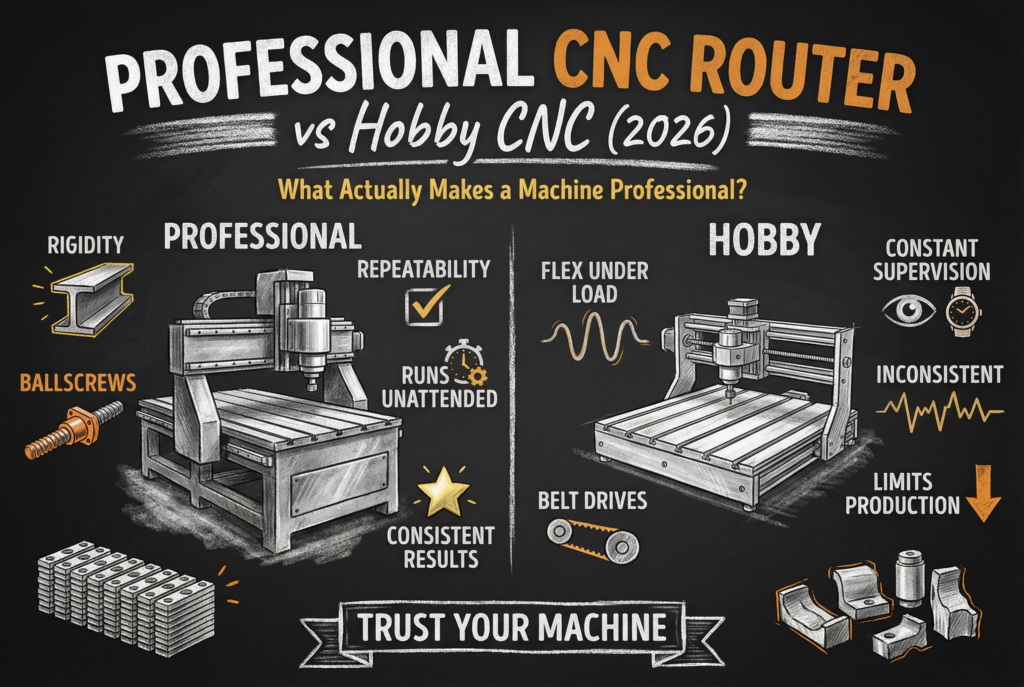
Many machines marketed as “professional” still rely on systems that introduce inconsistency like belts (👉 https://en.wikipedia.org/wiki/Belt_(mechanical)) or subpar motors. They might require that you monitor them constantly; they may produce slight variations between projects or parts; you may have to slow down cuts and thus production; or they may fail when pushed beyond light-duty work. The difference between appearance and performance is where most buyers get burned. By appearance, I don’t just mean how it looks, it can be how it appears on the spec sheet as well.
What a Professional CNC Router Actually Means in 2026
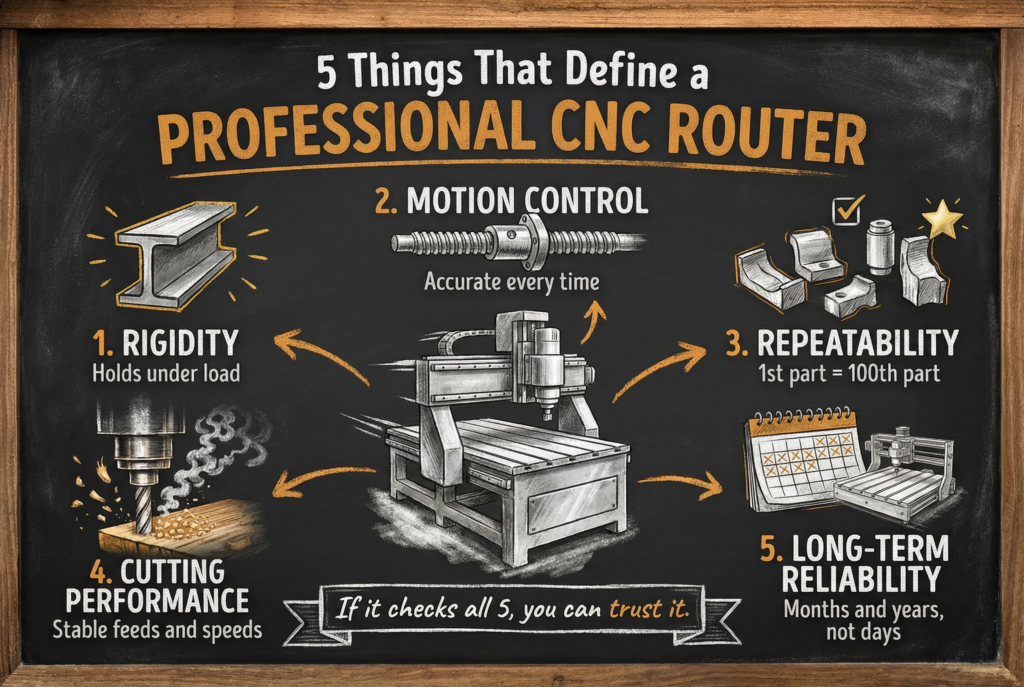
A professional CNC router isn’t defined by specs—it’s defined by performance. These five factors determine whether a machine can be trusted for real production.
A professional CNC router is defined by its ability to perform reliably in real-world conditions, not ideal ones. It is a system designed to produce consistent output over time, not just a machine that can achieve a clean result under perfect circumstances.
The distinction matters more than anything else. In your shop, you are dealing with variables: tool wear, materials are never consistent, longer jobs, and tighter timelines. A professional machine is built with those realities in mind.
This means the machine can maintain accuracy, repeatability, and performance across multiple runs without requiring constant adjustment, homing or supervision. Industrial machines do this. They run and keep running as long as they are maintained. They are stable under load, predictable in motion, and consistent from the first part to the last.
👉 Supporting concept: https://en.wikipedia.org/wiki/CNC_machining
A professional CNC router should act like an industrial machine without the cost or need for an industrial complex. If those qualities are not present, the machine may still be useful but it does not meet the standard of a professional CNC router.
Who Actually Needs a Professional CNC Router
Not everyone needs a professional CNC router, and pretending otherwise doesn’t help anyone. The need becomes clear when your work moves beyond experimentation and into consistency, output, and responsibility. You need the reliability of an industrial machine without the price tag or footprint.
👉 Related: https://fusioncncusa.com/professional-cnc-machine/
For builders, this transition often happens when work starts to stack up. What begins as a hobby or side hustle starts turning into consistent orders. At that point, the machine is no longer a tool for learning or small personal projects; it becomes a limiting factor. Slower cuts, inconsistent finishes and products, and the need to constantly supervise the machine begin to cost time, which is expensive, and kill confidence in the final product.
For small-format industrial shops or production-focused environments, the need is even more evident. Your machine is tied to customer timelines and revenue; any inconsistency and long timelines are not acceptable. Every unsuccessful cut, every holdup, and every adjustment directly affects your operations and costs you time and material. In business applications, a professional CNC router is not an upgrade; it is a requirement.
What Actually Defines a Professional CNC Router
There are a lot of features that get talked about in this space, but most of them miss the point. What matters is not the feature itself, but what it enables. A professional CNC router is defined by outcomes, by how it performs when it matters.
👉 Engineering reference: https://fusioncncusa.com/engineering-and-test-cnc-performance-testing/
First, rigidity plays a central role…
Second, motion control must be reliable and predictable…
👉 Ball screw reference: https://en.wikipedia.org/wiki/Ball_screw
Third, repeatability is critical…
👉 https://en.wikipedia.org/wiki/Repeatability
Fourth, cutting performance must remain stable under load…
👉 https://www.harveyperformance.com/in-the-loupe/what-is-chip-load/
Finally, reliability over time…
Final Thought: It Comes Down to Trust
At its core, the difference is simple. A professional CNC router is a machine you can trust.
👉 See example: https://fusioncncusa.com/professional-cnc-machine/
FAQ SECTION
Add this directly under your conclusion:
Frequently Asked Questions
What is a professional CNC router?
A professional CNC router is a machine designed to produce consistent, repeatable results under real working conditions, not just ideal ones. It maintains accuracy, stability, and performance across long jobs and repeated runs.
What is the difference between a hobby CNC and a professional CNC?
Hobby CNC machines are typically built for light use and require supervision. Professional CNC machines are built for reliability, repeatability, and sustained production with minimal oversight.
Why do ball screws matter in a CNC machine?
Ball screws provide precise, repeatable motion with minimal backlash, which is critical for accuracy and consistency in production work.
Can a CNC machine run unattended?
A true professional CNC machine can run with minimal supervision once properly set up, while hobby machines often require constant monitoring due to inconsistency or reliability issues.
Do I need a professional CNC machine for a small business?
If your work involves consistent output, customer deadlines, or revenue generation, a professional CNC machine becomes necessary to maintain reliability and efficiency.