
CNC job failure patterns show up the same way in almost every shop—you just don’t recognize them until it’s too late.
What defines a professional CNC machine
If you’ve ever ruined a part and didn’t understand why until the job was finished, you’ve already experienced one of the most common CNC job failure patterns. There’s a moment every CNC owner runs into sooner or later, and it almost always starts the same way.
Everything looks right. Your setup is clean. Feeds and speeds are dialed in. The tool is sharp. The material is secured. You go through your checklist, you look everything over one more time, and nothing stands out as wrong. So you hit start.
At first, everything sounds right. The motion is smooth, the spindle is cutting cleanly, and the job appears to be running exactly as you intended. There’s no chatter, no sudden shifts, no obvious red flags. It’s the kind of run that gives you confidence.
And then it finishes, and that’s when you see it.
If you’ve been around long enough, you start to recognize these CNC job failure patterns. They don’t always show up at the beginning, and they don’t usually announce themselves while the machine is running. They wait until the very end, when the cut is complete, and there’s nothing left to correct or that can be corrected.
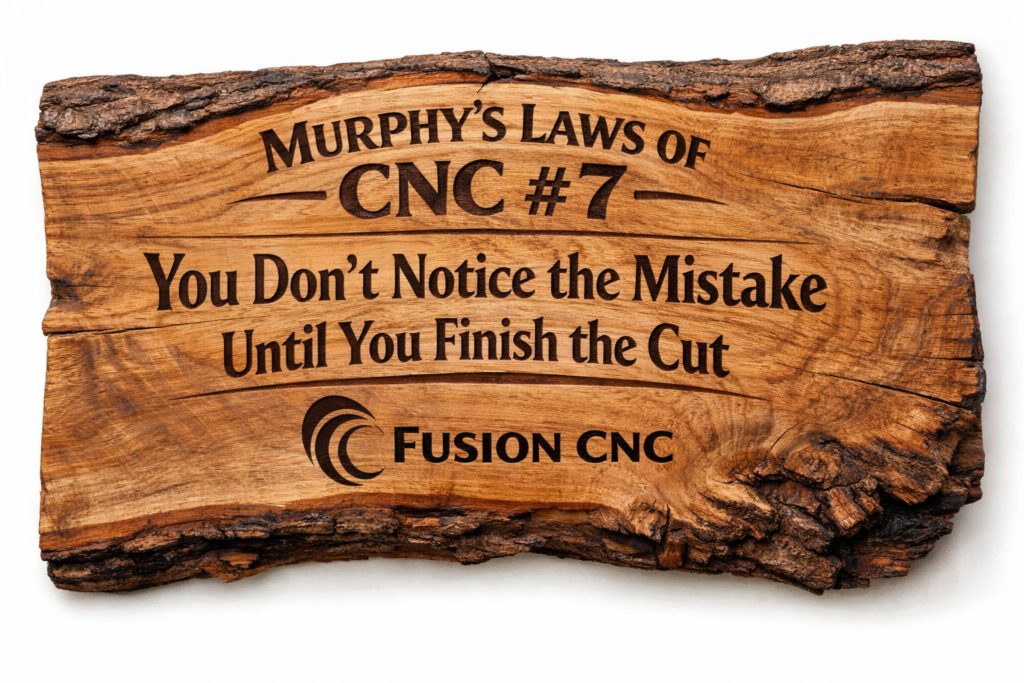
Murphy’s Law of CNC #7
You don’t notice the mistake until you finish the cut.
That’s the one that sticks with people, because it’s not just true, it’s painfully consistent.
It doesn’t matter whether the job took five minutes or five hours. It doesn’t matter if it’s a scrap piece or an expensive material you’ve been saving. The mistake hides itself just well enough to let the machine run all the way through, and it reveals itself at the exact moment when there’s nothing left to do about it.
You’re not catching it mid-cut. You’re not pausing the job in time. You’re standing there looking at a finished part that’s just wrong enough to matter.
How These CNC Job Failure Patterns Actually Show Up
What makes this frustrating is that it’s rarely something dramatic or obvious. It’s almost never a complete failure right from the start. Instead, it’s something small, something that didn’t seem important enough to slow down and double-check.
Maybe your zero was just slightly off. Maybe your workpiece shifted just enough to matter. Maybe a setting was carried over from the last job that you assumed was still correct. Maybe you told yourself, “That’s probably fine,” and moved on.
The machine doesn’t know the difference between “close enough” and correct. It just executes exactly what it’s told to do. And if something is off, even slightly, it will carry that mistake all the way through the cut without hesitation.
Professional CNC machine built for real work
That’s what makes these CNC job failure patterns so consistent. They don’t come from catastrophic decisions. They come from small assumptions that stack up quietly until the job is done.
You Start to Recognize CNC job Failure Patterns After They Happen Enough Times
Once you’ve been through it a few times, you start noticing something else. The same types of problems keep showing up, just in slightly different forms. These are CNC job failure patterns, and they are not always the same, but they are patterns.
You begin to realize that your machine somehow always seems to “know” when you’re in a rush. Jobs that should have gone smoothly suddenly become unpredictable the moment time starts to matter. It’s not that the machine changed; it’s that your approach did.
You’ll also notice that feeds and speeds that worked perfectly before suddenly feel off the moment you hit start on a real job. What looked good in testing doesn’t always translate the way you expected when it actually counts.
And then there’s the one everyone learns sooner or later: the more expensive the material, the less forgiving the outcome seems to be. The job that would have gone perfectly on scrap, quickly setting it up and turning the machine loose to do its thing, suddenly reveals every small mistake when it actually matters.
These are recurring patterns, not isolated events. Once recognized, they reshape how you see every job.
Why These CNC Job Failure Patterns Always Hit at the Worst Time
There’s a reason these moments stick with you more than the successful runs.
They don’t happen randomly. They happen when the job matters.
They show up when you’re trying to meet a deadline. They show up when someone is watching. They show up when you’ve already invested time, material, and effort into getting everything ready. And they show up when you’re confident that everything is finally going to go right.
That’s what makes them frustrating, but it’s also what makes them valuable. These moments force you to pay attention in a way that smooth runs never do. They highlight the exact points where your process breaks down, even if everything looked fine on the surface.
Over time, those moments start to shape how you work.
What’s Actually Behind These CNC Job Failure Patterns
If you strip all of this down to the root cause, CNC job failure patterns usually comes back to a few simple things.
Rushing is one of the biggest. The faster you try to move, the more likely you are to skip something small that ends up mattering later. Not because you don’t know better, but because you’re trying to get to the next step.
Assumptions are another major factor. It’s easy to trust that something is set correctly because it worked last time, or because it looks right at a glance. But CNC doesn’t reward assumptions. It rewards verification.
And then there’s the idea of “close enough.” In most areas of life, being close is often good enough. In CNC, that small margin can be the difference between a clean part and a finished piece that doesn’t meet your expectations.
None of these is a complicated mistake. That’s what makes them so easy to repeat.
You Don’t Eliminate These—You Learn to See Them Earlier
One of the biggest misconceptions is that experience eliminates these problems completely. It doesn’t.
What experience actually does is change when you notice it.
Instead of seeing the mistake at the end of the job, you start catching it earlier. You pause longer before hitting start. You double-check the things you used to assume were fine. You build habits that slow you down just enough to avoid the same outcomes.
CNC job failure patterns don’t go away. They just lose their ability to catch you off guard.
The real takeaway: the value lies in learning to spot these patterns earlier and building habits that prevent repeat mistakes.
Final Thought
If you’ve spent any real time running CNC, you already know this: the real skill is not eliminating mistakes altogether, but learning to see them before they ruin a nice piece of material.
The machine doesn’t make random mistakes. It reflects exactly what you give it, whether that’s precision or oversight. And when something goes wrong, it usually traces back to a moment that felt small at the time.
That’s why Murphy’s Law of CNC #7 hits the way it does.
You don’t notice the mistake until you finish the cut, and by then, the lesson is already carved in—usually into the part you just ruined.