
Category: CNC Education | Performance | Shop Fundamentals
Explore tools, upgrades, and accessories: https://fusioncncusa.com/fusion-cnc-shop/
If you’ve spent any real time in front of a CNC, you already know this: when CNC machine performance is dialed in, the entire shop feels different.
The sound changes. The cut looks cleaner. You stop hovering over the E-stop button like you’re waiting for something to go wrong.
And when things aren’t quite right? You feel it immediately.
You lean in. You listen harder. You start second-guessing feed rates, material, tooling… maybe even yourself.
Here’s the truth most people eventually learn: improving CNC machine performance rarely requires dramatic upgrades or exotic modifications. It usually comes down to fundamentals — small, consistent decisions that compound over time.
And once you understand that, dialing in your machine becomes less stressful… and honestly, kind of satisfying.
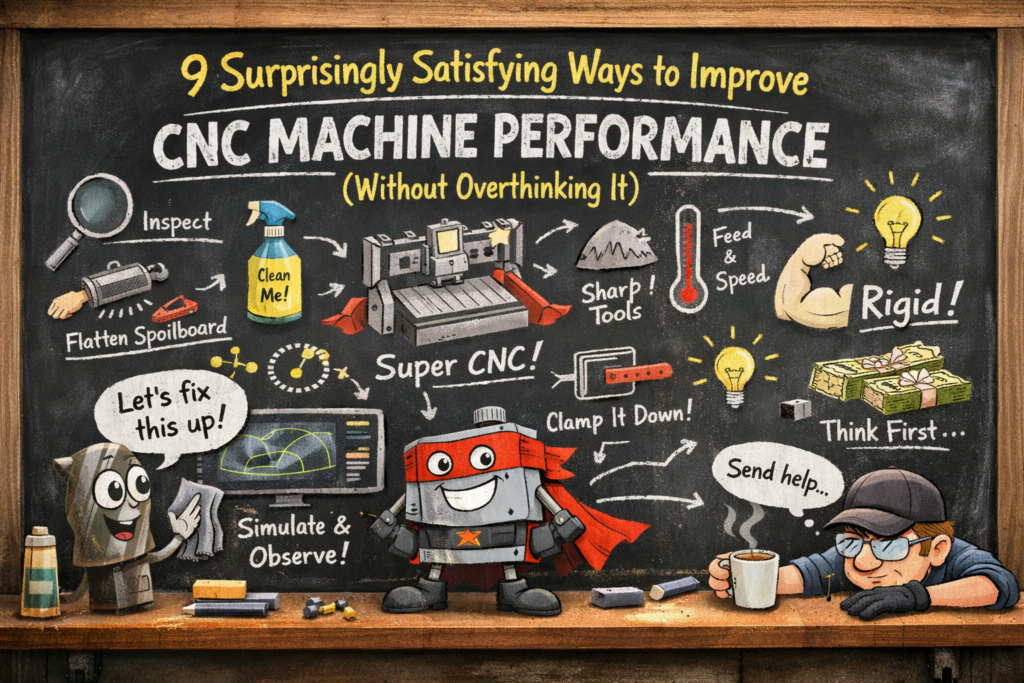
Let’s walk through nine practical, real-world ways to strengthen CNC machine performance without overcomplicating your shop life.
1. Clean the Machine Like It’s a Precision Tool (Because It Is)
Dust doesn’t just make your shop look productive. It quietly interferes with how your machine behaves.
Linear rails, ball screws, bearings, and drive systems are engineered for controlled motion. When chips pack into corners or fine dust coats moving components, resistance increases. That resistance turns into vibration. And vibration shows up in your finish quality and repeatability.
CNC machine performance rarely collapses overnight. It drifts.
That’s why simple habits matter:
- Brush off rails before shutdown
- Clear chip buildup from corners
- Inspect motion components regularly
- Keep exposed parts clean if your machine design requires it
On machines with enclosed motion systems (like ours), maintenance intervals stretch significantly. If rails and ball screws are protected, you may only need to check them every few months. On fully exposed systems running heavy production, it might be daily.
The Society of Manufacturing Engineers consistently reinforces the link between preventive maintenance and sustained equipment performance.¹
Lower friction. Better consistency. Every time.
2. Surface Your Spoilboard and Reset the Baseline
Few things impact CNC machine performance more than your reference plane.
If your spoilboard isn’t flat relative to the gantry, depth variation sneaks in. Pockets won’t match. Through-cuts barely miss. You start tweaking settings when the real problem is geometry.
Surfacing your spoilboard resets the baseline. It aligns the cutting plane with your machine’s actual motion path.
Also — and this is overlooked — spills matter. Oil, grease, even coffee can warp sections if they soak in. If it penetrates deeply, you may need to resurface or replace that section entirely.
Visual flatness is not mechanical flatness.
We’ve discussed similar issues in detail here:
https://fusioncncusa.com/cnc-woodworking-mistakes-explained/
When your baseline is true, your cuts become predictable again.
And predictability is where confidence starts.
3. Match Tool Geometry to Material — Intentionally
Tool geometry has a massive influence on cutting results, yet it’s often treated like an afterthought.
Upcut bits evacuate chips aggressively. Downcut bits protect the top surface. Compression bits balance both in sheet goods. Each design changes chip flow, heat management, and edge quality.
If you haven’t reviewed tooling fundamentals recently, revisit these:
• Complete guide to cutting tool geometry:
https://fusioncncusa.com/the-complete-beginners-guide-to-cnc-cutting-tool-geometry-why-your-tools-matter-more-than-you-think/
• Upcut vs Downcut vs Compression bits:
https://fusioncncusa.com/blog-upcut-vs-downcut-vs-compression-bits/
Your machine can only perform as well as the cutter allows.
Sometimes improving CNC machine performance doesn’t mean adjusting settings at all — it means choosing the right tool.
4. Feed Rate Is a Performance Lever — Not a Safety Blanket
Slowing everything down feels cautious.
It also often makes things worse.
When feed rates are too low, the cutter rubs instead of cuts. Rubbing generates heat. Heat dulls edges. Dull edges degrade finish quality. And then people slow down even more — which compounds the problem.
CNC Cookbook and other machining references consistently emphasize proper chip load over timid feeds.²
Healthy chips mean healthy cuts.
When feeds and speeds are balanced correctly, your machine sounds better, runs cooler, and produces cleaner edges. That improvement in CNC machine performance feels immediate — and audible.
5. Improve Workholding Before Adjusting Anything Else
Movement is one of the fastest ways to sabotage good results.
Even slight shifting introduces chatter. Chatter ruins surface finish and depth consistency. Many operators instinctively adjust speeds when the real problem is instability.
Better workholding improves cutting consistency instantly.
Whether you use clamps, fixtures, or vacuum systems, eliminate movement first. Stable material produces stable results.
Before you blame the spindle, blame the physics.
6. Understand the Role of Rigidity
Rigidity is not marketing language. It’s mechanical reality.
Under load, less rigid machines deflect. That deflection affects cut quality and repeatability. A more rigid structure resists movement and maintains alignment under identical conditions.
That’s one reason we publish engineering and testing data openly:
https://fusioncncusa.com/engineering-and-test/
When structure is solid, CNC machine performance becomes easier to manage because fewer hidden variables are at play.
Learning becomes clearer when the platform itself isn’t flexing against you.
7. Maintain Motion Components Before They Complain
Rails, bearings, ball screws, and belts rarely fail dramatically.
They degrade gradually.
As friction increases and tolerances loosen, overall performance declines slowly enough that many operators adapt without realizing it.
Periodic inspections. Scheduled lubrication. Hardware checks.
OSHA maintenance guidelines reinforce proactive inspection to prevent performance drift.³
Maintenance isn’t glamorous.
It is foundational.
8. Simulation Is Helpful — Observation Is Essential
CAM simulation is powerful. It prevents collisions and visualizes toolpaths.
But simulation doesn’t account for humidity, wood density variation, slight tool wear, or vibration harmonics.
Watching early passes. Listening to tone changes. Observing chip formation.
Those habits refine real-world cutting performance beyond what software alone can predict.
Simulation guides. Observation perfects.
9. Upgrade With Clarity, Not Emotion
At some point, improving CNC machine performance may involve hardware decisions — more spindle torque, greater rigidity, improved motion control.
Upgrading can absolutely make a difference.
But only when it solves a clearly defined limitation.
Before making that decision, ask:
- Is this a tooling issue?
- Is this a setup issue?
- Is the structure flexing?
- Am I hitting a power ceiling?
Intentional upgrades improve results.
Emotional upgrades increase expenses.
If you’re evaluating machines, explore details here:
https://fusioncncusa.com/cnc-machines/
If you’re refining your current setup, tooling and accessories are here:
https://fusioncncusa.com/fusion-cnc-shop/
Why Improving CNC Machine Performance Feels So Good
Here’s something that doesn’t get talked about enough.
Improving CNC machine performance is deeply satisfying.
Not flashy. Not dramatic.
Measurable.
You clean a rail — the sound smooths out.
You surface a spoilboard — pockets become consistent.
You correct feed rate — edges sharpen instantly.
Cause and effect.
Frustration turns into refinement.
Guessing turns into confidence.
And once that shift happens, you stop fighting the machine — and start working with it.
Quick Summary
Improving CNC machine performance does not require reinvention.
It requires:
- Clean components
- True reference surfaces
- Correct tool geometry
- Balanced feeds and speeds
- Stable workholding
- Structural rigidity
- Preventive maintenance
- Observant operation
- Intentional upgrades
None of these are magic.
All of them work.
References
- Society of Manufacturing Engineers (SME) – Preventive Maintenance & Equipment Performance
https://www.sme.org/ - CNC Cookbook – Feeds, Speeds, and Chip Load Theory
https://www.cnccookbook.com/ - OSHA Machine Maintenance Guidelines
https://www.osha.gov/machine-guarding - Machinery’s Handbook – General Machining Reference
https://www.industrialpress.com/machinery-handbook/